

Accessibility with Blackboard Ally
- Accessibility
Last modified: September 24, 2026
Ally has tools that can help instructors monitor how accessible their course is.

Recommended viewing
Ally can assist in correcting accessibility issues, and provide alternative formats to students.
Alternative Formats
As educators we know that learning styles among students can vary dramatically meaning that the needs of all students cannot be met in the same way. One way that Ally helps with this is by providing alternative formats for many of the resources you post. Some of the available alternatives are determined by the type of file that you upload, but most documents will have some or all of the following alternatives available:
- Tagged PDF - A tagged and accessible version of the original document, making it easier for screen readers to navigate.
- HTML - A responsive web version that can be read on any device, improving accessibility and usability.
- ePub - A flexible, reflowable format that adapts to various devices and allows for customizable text size and layout.
- Electronic Braille - A format compatible with refreshable braille displays for visually impaired users.
- Audio - A text-to-speech version of the content that allows users to listen to the document as an audio file.
- Beeline Reader - Enhances on-screen reading by applying color gradients to guide the reader's eyes along lines of text.
- Immersive Reader - A tool that provides options like text-to-speech, translation, and focus mode to improve comprehension and accessibility.
- Translated Version - A machine translated version of the original document
The icon for downloading alternative formats looks like the letter “A” and a downward-pointing arrow:
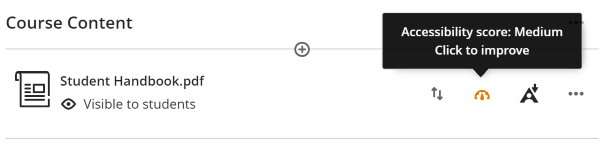
Clicking on the icon will bring up the list of alternative formats for students to choose from. If you would like to learn more about these individual formats and their uses, see our handout for students. You can post this handout in your Blackboard course in a place where students will be able to quickly find and access it.
When Ally is enabled, icons that look like gauges show up on posts that you add to your Blackboard course to indicate the level of accessibility. Only you see these, not students. Here’s what those icons mean:

Clicking on the gauge will take you to suggestions for improving your content.
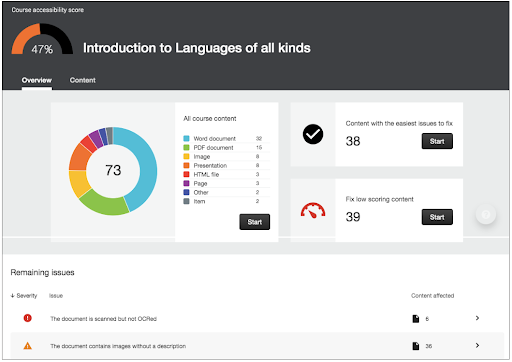
Ally also creates an Accessibility Report regarding your course as a whole. You can find the link to this report under Course Tools. This report will detail the types of content in your course, your course’s overall accessibility rating, issues that can be fixed to raise your score, and a list of issues in order of severity. It will look something like this:
Making your PDFs Accessible
Scanned PDFs are really not accessible! If you can, try to get to the full text. You might find it for free online or via our library. See Blackboard’s suggestions.
Sometimes, you don’t have any other option. In that case you can use Ally (available in Blackboard) to OCR the text and fix some or all of the resulting issues.First, check that you have Ally enabled for your course under control panel > customization > tool availability.
Use the Upload option to add a PDF file to your course.
You will see a colored gauge. Scores range from Low (red) to Perfect (green). The higher the score the fewer the issues.
Under Alternative formats select: “OCRed PDF” and download your file. Be sure to name it something new like “revisedPDF”. Upload the new version to your course.
 The Alternative format icon looks like the capital letter A with a down arrow
Troubleshooting
If there is no OCR option in Ally or your document still has a low score after uploading it, then the PDF is OCR’d but requires further attention. You will need to read what the specific accessibility issues are and fix them.
You may be able to download the “HTML” alternative format to fix certain issues.
If you are still having trouble getting your document to at least “high” accessibility,contact CELT for more help.