
UAS, Tlingit & Haida sign memorandum to advance Indigenous educational opportunities
MOU lays groundwork for long-term partnership, innovation and vision for a School of Indigenous Studies at UAS.
Juneau, Alaska
Date of Press Release: March 27, 2026
Updated on April 23, 2026.
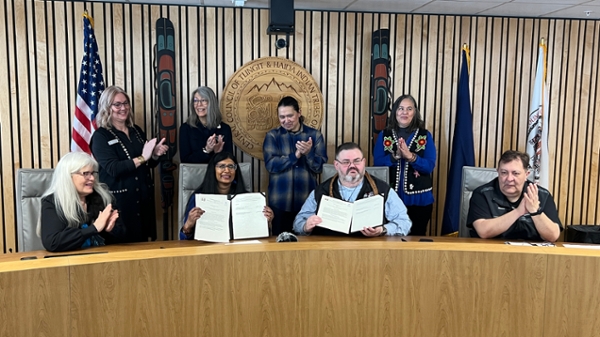
The University of Alaska Southeast and the Central Council of the Tlingit & Haida Indian Tribes of Alaska have entered into a memorandum of understanding, laying the groundwork for long-term partnership and innovation. At the center of the agreement is the co-creation of a vision for a School of Indigenous Studies at UAS.
“This is a historic day,” said UAS Chancellor Aparna Palmer, Ph.D, at the March 27 signing at the Tlingit & Haida Executive Council chambers. “Rarely is it the case that a tribe and a university come together as equal partners to create a vision for education. We are honored and humbled to have the trust of Tlingit & Haida, and we proudly stand with them as we embark on this journey.”
The memorandum emerges from a shared vision for an educational model rooted in community, culture and place. The envisioned model is responsive to Indigenous communities and community-identified goals, shaped by Indigenous knowledge, leadership, and sovereignty, and inclusive of cultural knowledge systems.
“There’s leadership within the university system that we can truly lock arms with—leadership that understands the importance of uplifting Indigenous studies at every level," said Tlingit & Haida President Chalyee Éesh Richard Peterson. “Together, we are creating space for our own Indigenous educators to lead, and for our people—who so richly deserve these opportunities—to earn their degrees. This agreement reflects a shared commitment to building a bold vision for what a School of Indigenous Studies can and should be.”
The agreement serves as a foundation for collaboration, with guiding principles of mutual trust, respect for sovereignty, co-design and co-ownership of the vision, accountability and communication, and commitment to place.
Moving forward, the partners will begin a formal dialogue around the School of Indigenous Studies, identify opportunities for pilot programs and joint initiatives, and form a working group to co-develop a roadmap.
Once a structure for the School of Indigenous Studies has been developed, it will be submitted for approval by Tlingit & Haida and the University of Alaska Board of Regents.
Palmer said the opportunity to collaborate on creating a vision for the school is “truly remarkable.”
“It's an opportunity to continue to integrate, celebrate and shape the education that we offer at UAS with the values and the traditions of Indigenous Peoples,” Palmer said. “It is also an opportunity to prosper together, grow our economic vitality and meet our workforce needs in a way that honors our shared priorities and our shared values.”
UAS currently offers learning pathways in Northwest Coast arts, Indigenous languages, Indigenous language teaching, Indigenous studies and Alaska Native studies. The integrative behavioral health program is expanding courses on Indigenous health and healing, including a new certification. Partnerships with Indigenous organizations, including Sealaska Heritage Institute and Goldbelt Heritage Foundation, have been integral to these offerings.
The memorandum initiates the process of envisioning possibilities for expanding these options. This could include adding new programs, such as in Indigenous sciences or Tribal administration, or offering more advanced degrees through existing pathways.
Tlingit & Haida has long invested in early childhood and K-12 education initiatives through Head Start, the LEARN childcare program, and several youth engagement programs. In 2025, the Tribe launched a foundation to advance education, self-determination and wellness, starting with a capital campaign to fund a 12-acre Tribal education campus for early childhood through college students.
“This is just the beginning of our formal collaboration, but we have arrived here through years of relationship and trust-building, and envisioning what is possible," said Jacqueline Tagaban, UAS associate vice chancellor for Alaska Native programs and director of the Preparing Indigenous Teachers & Administrators for Alaska Schools (PITAAS) program. “We are immensely grateful to those who have laid the groundwork to bring us here. We hope this enables our children to reach for dreams and aspirations beyond what we could have imagined–ones deeply rooted in this place.”
Image Gallery
Additional Resources
Links
Press Release Contact
Central Council of the Tlingit & Haida Indian Tribes of Alaska
dhutchinson@tlingitandhaida.gov